What Is Machine Foundation Flatness?
Machine foundation flatness is a precision measurement discipline distinct from standard floor flatness testing. While floor flatness (measured by the ASTM E1155 F-number system) governs general concrete slabs for warehousing and commercial use, machine foundation flatness addresses the much tighter tolerances required by industrial equipment — CNC machining centers, large presses, compressors, turbines, pumps, and automated production lines.
When a machine is installed on a foundation that is out of tolerance, the consequences include misalignment of drive trains, accelerated bearing wear, vibration, reduced precision output, and premature failure. For high-value capital equipment, a poorly prepared foundation can cost more in downtime and repairs over the equipment’s life than the cost of proper preparation and verification up front.
Why Machine Foundation Flatness Matters
Industrial equipment is designed to operate within specific geometric tolerances. Machine tools in particular are manufactured to tight straightness, squareness, and flatness specifications — but those tolerances assume a compliant foundation. Placing precision equipment on an out-of-flat foundation introduces systematic errors that cannot be corrected through machine calibration alone.
Common consequences of inadequate foundation flatness:
- Misalignment between machine components and coupled systems
- Resonance and vibration at operating speeds
- Reduced tool life and surface finish quality in machining applications
- Premature wear on leveling feet, mounting pads, and anchor bolts
- Voided equipment warranties — most OEMs specify foundation requirements
Standard Tolerances by Machine Type
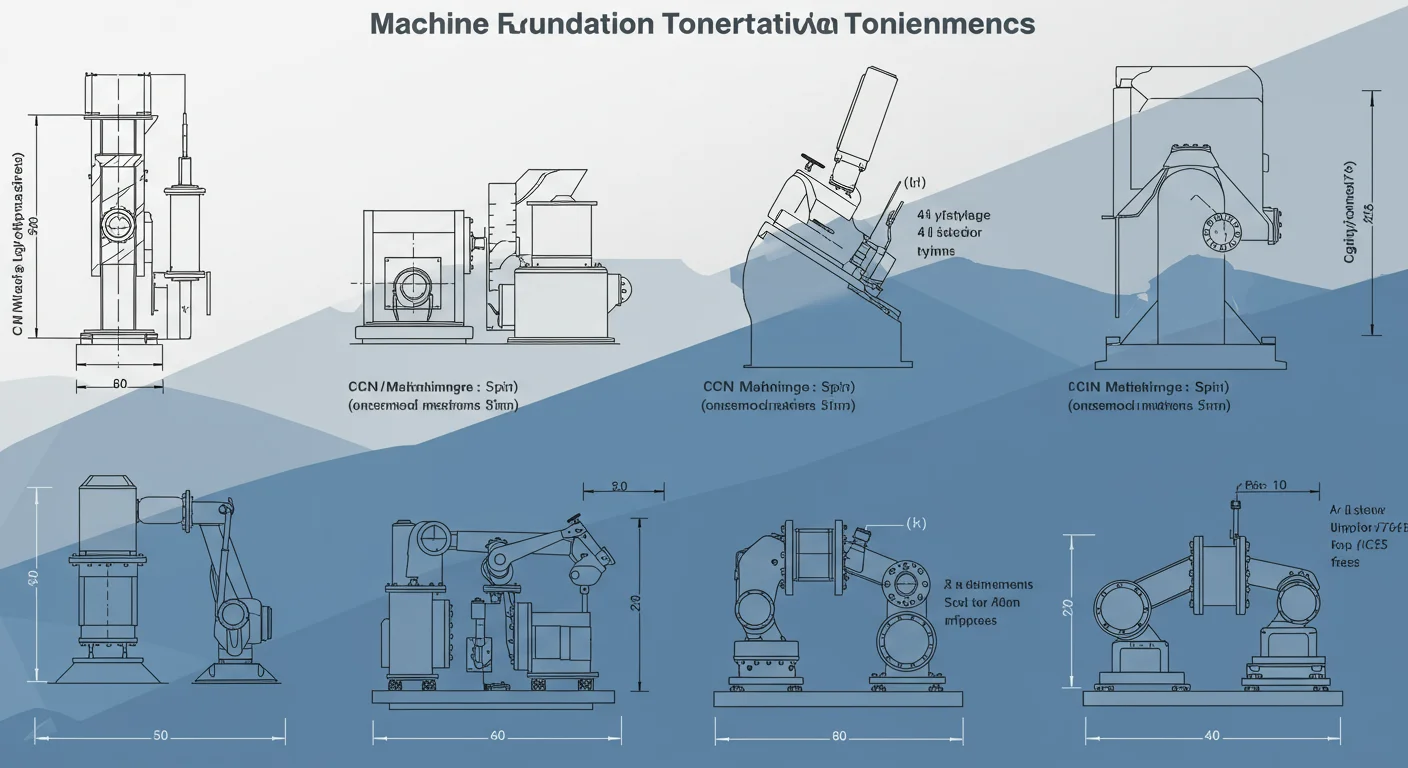
Machine foundation flatness tolerances are specified by the equipment OEM in their installation manuals and are not universal. General ranges by equipment category:
| Equipment Type | Typical Flatness Tolerance | Notes |
|---|---|---|
| CNC Machining Centers | 0.001″ – 0.003″ per foot | OEM-specific; verify installation manual |
| Large Stamping Presses | 0.002″ – 0.010″ total | Depends on bed size and tonnage |
| Rotating Machinery (Compressors, Pumps) | 0.002″ – 0.005″ under baseplate | Critical for shaft alignment |
| Industrial Robots | 0.001″ – 0.002″ at mounting points | Multi-axis robots especially sensitive |
| General Production Equipment | 0.005″ – 0.020″ total | Depends on operational precision requirements |
Note: These are general ranges. Always use the specific tolerance from your equipment OEM’s installation requirements.
Testing Methods for Machine Foundation Flatness
Standard ASTM E1155 floor flatness testing is not sufficient for machine foundation applications — the tolerances are tighter and the measurement grid is defined by the equipment footprint, not by general survey paths. Methods used for machine foundation measurement include:
- Precision Laser Level Survey: A rotating or scanning laser establishes a reference plane; elevation deviations are measured at defined grid points across the foundation pad. Accurate to ±0.001″ over typical foundation dimensions.
- Electronic Level / Digital Inclinometer Grid: A precision digital level is placed at multiple grid points to measure angular deviation from level. Useful for assessing co-planarity of mounting points.
- Dial Indicator on Reference Straight Edge: Used for smaller foundations; a precision straightedge is placed across the surface and dial indicators measure deviation at defined intervals.
- 3D Laser Scanning: Provides a full surface map and can be compared to design tolerances; increasingly used for large foundations with complex geometry.
Measurement and Reporting
Machine foundation flatness reports should document:
- Measurement method and instrument calibration records
- Grid layout and measurement point locations relative to equipment anchor bolt pattern
- Measured elevation or deviation at each point
- Maximum deviation across the foundation surface
- Pass/fail comparison to OEM specified tolerance
- Recommended remediation for any out-of-tolerance areas
Specification Writing for Machine Foundations
When writing foundation flatness specifications for capital equipment projects, specify:
- The tolerance (source: OEM installation manual, referenced by document number and revision)
- The measurement method (laser survey, digital inclinometer, etc.)
- The measurement grid (typically at anchor bolt locations plus intermediate points at 12″–24″ intervals)
- The acceptance criterion (maximum deviation, not average)
- The party responsible for measurement (owner, contractor, third-party inspector)
- Timing of measurement (before equipment set, after grouting, after final leveling)
Working With Equipment OEMs
Before finalizing a foundation design or construction specification, request the OEM’s foundation drawing and installation requirements. Most major equipment manufacturers provide these documents and they contain:
- Minimum concrete compressive strength (typically 3,000–4,000 psi)
- Flatness and levelness tolerances at anchor bolt locations
- Anchor bolt pattern and embedment depth
- Vibration isolation requirements
- Grouting specifications
Remediation Options When Tolerances Aren’t Met
If foundation survey reveals out-of-tolerance areas prior to equipment set:
- Diamond grinding: Reduces high spots; effective for localized deviations
- Epoxy grout leveling: Build up low areas; most OEMs require epoxy grout rather than cementitious grout under precision equipment
- Full re-pour: For severe deviations; typically a last resort
After equipment installation, precision leveling is performed using the machine’s own leveling feet and checked with a precision level or laser tracker — but this cannot compensate for a foundation that is significantly out of tolerance.
Get Foundation Flatness Testing for Your Equipment
IFTI provides precision machine foundation flatness surveys for capital equipment installations in manufacturing, heavy industry, and process facilities. We deliver formal reports with OEM tolerance comparison and remediation recommendations.
Contact IFTI to schedule your foundation survey.
Frequently Asked Questions
What is machine foundation flatness?
Machine foundation flatness is the precision measurement of how close a concrete equipment pad surface is to a true flat plane, expressed in thousandths of an inch or mm/m. It is critical for industrial equipment alignment, vibration control, and long-term mechanical performance.
What tolerances are required for machine foundations?
Tolerances vary significantly by equipment type and are specified by the OEM. CNC machining centers typically require 0.001″–0.003″ per foot; rotating machinery 0.002″–0.005″ under the baseplate. Always use your specific equipment manufacturer’s installation requirements.
How is foundation flatness tested?
Machine foundation flatness is typically measured using precision laser level surveys, digital inclinometer grids, or dial indicator measurements on precision straightedges — methods that provide accuracy to ±0.001″ or better, which exceeds the capability of standard ASTM E1155 floor flatness profilers.
Who specifies machine foundation flatness?
Machine foundation flatness requirements are specified by the equipment OEM in their installation manuals. The project specification should reference the OEM document and assign measurement responsibility to a qualified third-party testing firm or the installing contractor.