A full-surface elevation survey maps every high and low spot on a measured grid, against the tolerance your floor is actually installed to, so flatness problems get found while they're still cheap to fix.
FF/FL grades how well a slab was placed. A floor flatness survey shows where the low spots are, how big they are, and what to do about them.
56 seconds. Voice-over, music and captions.
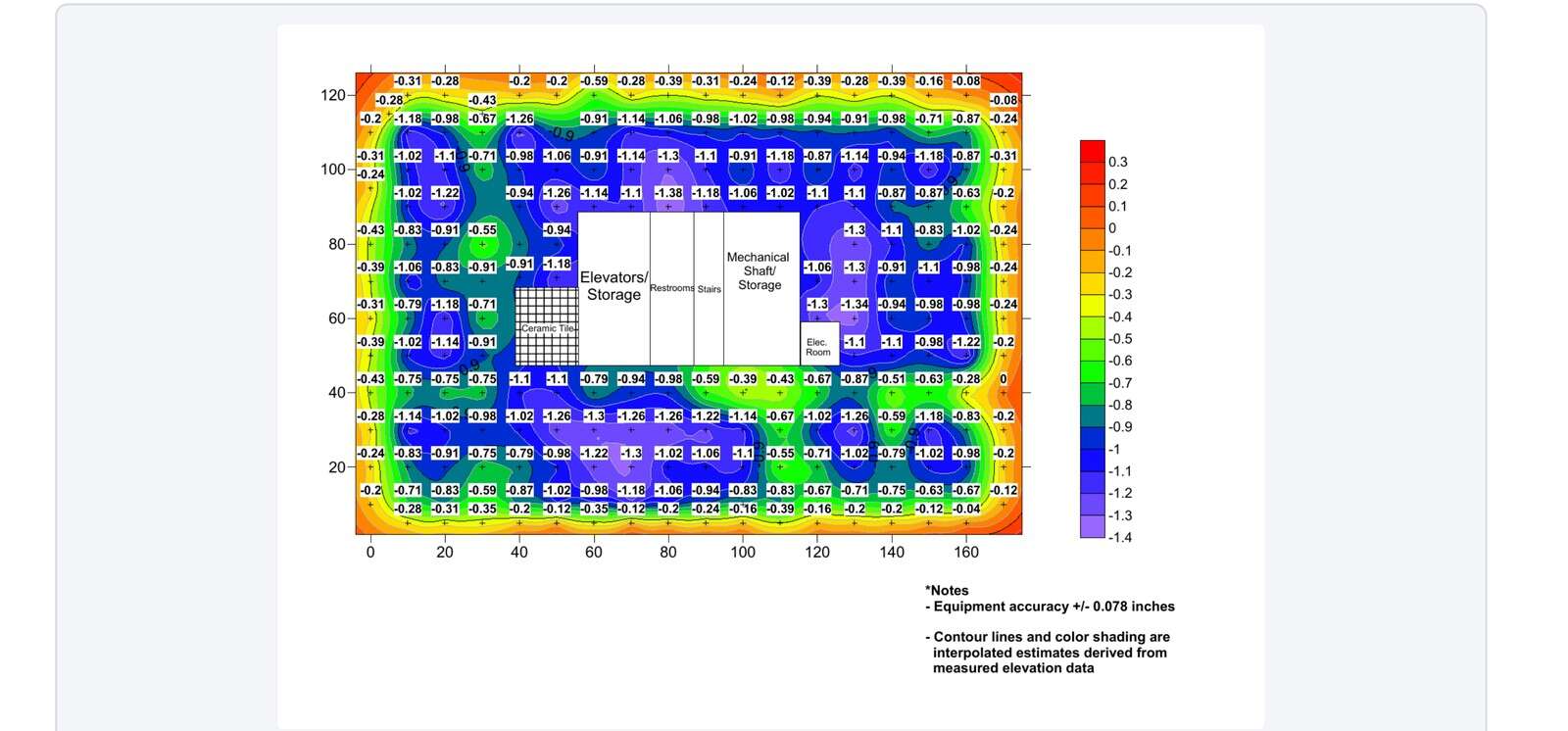
A pass/fail number tells you a floor has a problem somewhere. We capture the whole surface once, then turn that field data into whichever view answers your question, from a color contour map to a cut-and-fill plan.
Every output is configured to the project.
The elevation surface, drawn as contour lines with a measured value at every grid point.
A clean color grid of normalized elevations, high to low, read at a glance.
Pass or fail against your stated tolerance, zone by zone, with the pass percentage.
Side-by-side material estimates for each fix strategy, so you can compare before committing.
Exactly where, and how much, leveler or grinding goes down to hit tolerance.
The resulting surface after the recommended remediation is applied.
The 1:1 solution: the lowest total material that still holds the spec.
The 5:1 solution: fill-favored, to minimize grinding and dust on occupied sites.
Slope magnitude checked against a minimum, for floors that have to drain.
The direction water runs at every point, mapped across the whole floor.
Your architectural or MEP plan registered directly over the elevation surface.
The Sample Report walks every output: what it shows, why it matters, how to read it.
Tell us the project, the timeline, and the flooring system going down. No obligation, no sales sequence.
Specialists measure the full slab with digital altimeters on a grid, working around the other trades. Non-destructive.
Detailed elevation mapping, identified problem areas, and recommended next steps, in the same format on every project.
If your spec cites ASTM E1155 F-numbers but flooring goes down weeks later, you almost certainly need an elevation survey, not an FF/FL test. Here's the difference, plainly.
F-numbers grade how well the finishers placed the slab, measured within roughly 72 hours of the pour. After that the reading is no longer valid: curing, shrinkage, and construction traffic have already changed the floor. It's a concrete QC tool, and a good one, for that one job.
We measure the slab as it is the day flooring is installed, against your manufacturer's installation tolerance (often 1/8" or 3/16" in 10'). That's what your spec actually intends: a floor flat enough to accept its finish. It's valid whenever we walk it, weeks or months after the pour.
"$48,000 in leveler." On what basis?
The survey turns a round number into low areas, square footage, and quantities. Approve it, negotiate it, or reject it, with data instead of a gut check.

The slab really does need it. Prove it.
When a walk-through can't document what you're seeing, the survey is your substantiation: independent, quantified, and signed by a party with nothing to sell you.
Change orders backed by survey data get approved, because there's nothing left to argue about.
Flatness issues surface early, before they collide with schedules and the other trades on site.
The finish goes down on a surface it can actually accept, cutting callbacks and remediation.
We measure the entire slab on a grid, not selective sampling, so prep is priced, not gambled.
A plain-language guide to why FF/FL numbers can't enforce what your spec intends, the elevation-survey language that can, and how a multi-site program builds verification into the rollout.
The 72-hour problem, explained for owners and spec writers.
See the actual contour map and quantities you'd receive.

PDF · delivered instantly
"*" indicates required fields
We'll email a copy too. No sales sequence, unsubscribe any time. Your details are used as described in our Privacy Policy.
A full-surface measurement of a slab's elevation, captured on a grid with digital altimeters and rendered as a contour map. It shows every high and low area across the floor, with quantities, rather than a single pass/fail number.
Our service is the elevation survey, which is what most flooring specs actually need. FF/FL (ASTM E1155) grades placement quality within about 72 hours of the pour; it expires long before flooring is installed. If your project genuinely needs E1155 placement QC on a fresh pour, we'll tell you plainly and point you to the right resource.
For verifying a floor is flat enough to accept its finish at installation, yes, that's exactly what the elevation survey measures. For contractual placement QC within 72 hours of the pour, no. The two answer different questions at different moments.
Yes. Because we measure the full surface, the contour data converts directly into low-area square footage, depths, and estimated leveler quantities, the basis for pricing prep or evaluating a change order.
Our digital altimeter equipment measures to within roughly ±0.078 inches, and every report states the equipment accuracy on the map. Contour values are a faithful model of the surface, not rounded estimates.
Yes. The survey is non-destructive and works on bare slabs or finished floors, which makes it useful for diagnosing a floor that's already failing as well as verifying one before installation.
That's one of the strongest uses of an independent survey. When the concrete sub and the flooring sub disagree, our data is the one reading in the room with no scope to protect, and it holds up if the dispute escalates.
We work across all 50 states, plus Canada and Puerto Rico, with nationwide fixed pricing. Send us the project details or the spec and we'll schedule a survey, usually with a same-day response.
Send the project or the spec section. If flatness isn't your real problem, we'll say so, and point you to what is.
"*" indicates required fields
Answered personally by an IFTI engineer, usually same day. Your details are used as described in our Privacy Policy.
